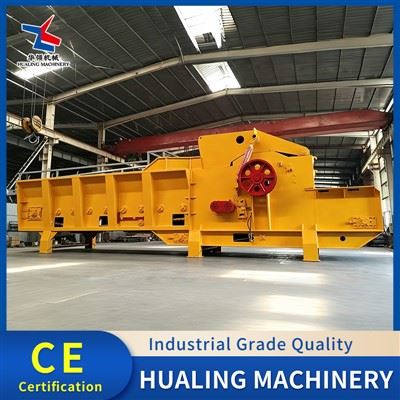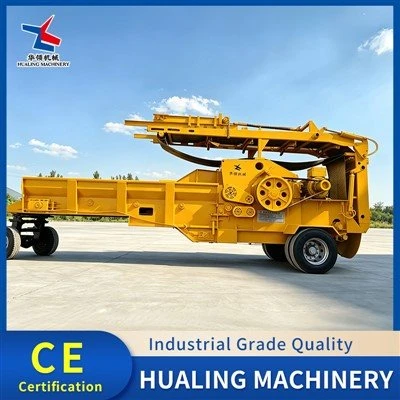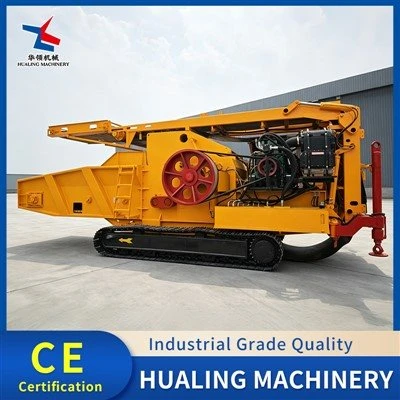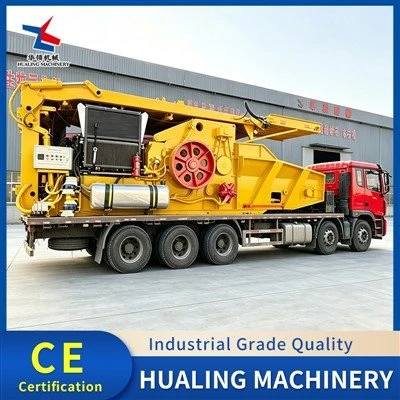

Based on their structure and working principle, log peeling machines mainly include roller type, ring type, rotor type, and hydraulic type.
Roller type peeling machines are a common type, and their technical specifications are defined by the industry standard LY/T 2166-2013.
Ring type peeling machines are suitable for peeling logs and small-diameter timber, and their advantage lies in processing small-diameter wood. While ring type peeling machines are advantageous for peeling small-diameter timber, double-roller peeling machines are suitable for peeling large-diameter timber.
Rotor type (double-roller/single-roller) peeling machines utilize a rotor with peeling teeth to cause the wood segments to circulate, rotate, and bounce, separating the bark through friction, impact, and compression. This type of peeling machine is highly efficient, achieving a peeling cleanliness of over 95%, with a wood loss rate of less than 2%. It is highly adaptable to curved logs, allowing for a curvature of up to 8%, and uses a dry peeling method, making it energy-saving and environmentally friendly.
It adopts an open hopper design, enabling continuous production line operation; the fixed casing results in low energy consumption, low failure rate, and low noise. It is suitable for peeling newly felled coniferous wood, some broadleaf wood, frozen wood, dry wood, as well as branch wood and bent wood.
The hydraulic peeling machine uses the rotary cutting principle of a chuckless veneer cutter, with a hydraulically driven feeding mechanism. It can simultaneously complete peeling and rounding processes, offering high efficiency, adjustable feed pressure, and convenient operation and maintenance. Typical models, such as the HBP series, can process logs with diameters of 140-500 mm and lengths of 1400-2600 mm.
All types of log peeling machines generally feature ease of use, low cost, high peeling efficiency, and minimal wood damage. They also excel in structural rationality, operational convenience, ease of maintenance, and adaptability to different tree species and diameters.