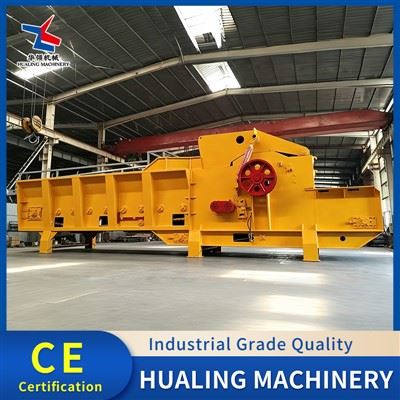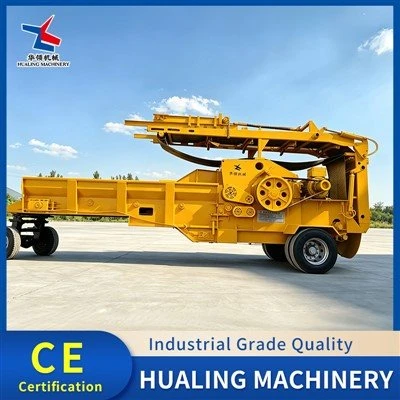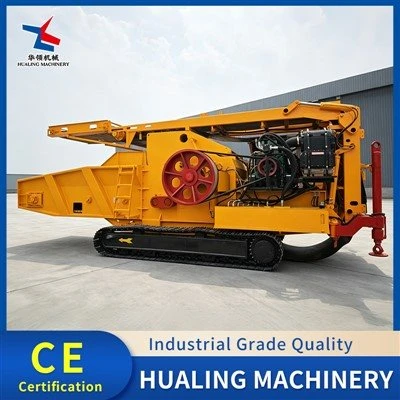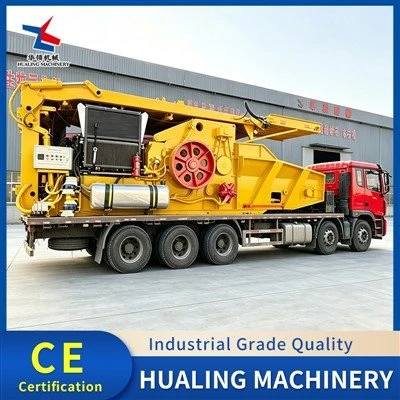

A mobile wood shredder includes: a vehicle body equipped with a traveling device; a rotary shredder disposed at one end of the vehicle body for shredding wood into wood fragments; a blade-type feeding device disposed on the upper part of the rotary shredder; a conveying device extending from the lower part of the rotary shredder towards the other end of the vehicle body in the direction of travel for conveying and discharging the wood fragments shredded by the rotary shredder to the outside; a drive traveling device disposed between the rotary shredder and the conveying device; a drive device for driving the rotary shredder, the blade-type feeding device, and the conveying device; and a drive unit for driving the rotary shredder, the blade-type feeding device, and the conveying device.
When the integrated wood crusher is working, the motor drives the rotor to rotate, and the feed hopper also rotates slowly under the same motor's drive. Material is fed into the feed hopper via a grabber. As the hopper rotates, the feeding teeth on the inner wall evenly distribute the material onto the rotor. The rotating rotor, upon contact with the material, achieves initial crushing through cutting and tearing by the blades on the rotor. The material, after initial crushing, falls onto the screen inside the crushing chamber under its own weight and the impact force of the rotor. Material that meets the requirements passes through the screen and is discharged, while material that does not meet the requirements undergoes secondary or even tertiary crushing within the crushing chamber until it meets the requirements.
This equipment uses an offset feed inlet combined with feeding teeth installed on the inner wall of the feed hopper to assist in feeding. Furthermore, the equipment employs frequency conversion technology; if the rotor load becomes too high, the feed hopper will rotate in reverse, helping to reduce material jamming. This equipment can be used for crushing large-diameter materials such as tree roots and waste furniture, as well as baled straw, and small-diameter wood and board scraps. It offers a relatively fast feeding speed. This equipment is easy to maintain. The hydraulically operated hopper tilting device allows for large-angle tilting when maintenance is needed, exposing the rotor for easy access. The equipment uses a multi-blade rotor roller for crushing; the blades are rationally arranged and made of specific materials, which helps extend their lifespan. The wood crusher has a high degree of automation; all electrical components are integrated into an automated control system, enabling remote wireless control, reducing manual operation, and contributing to production safety.