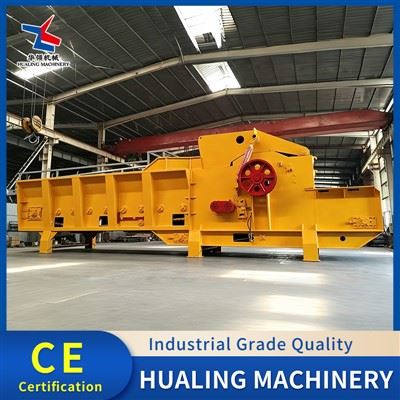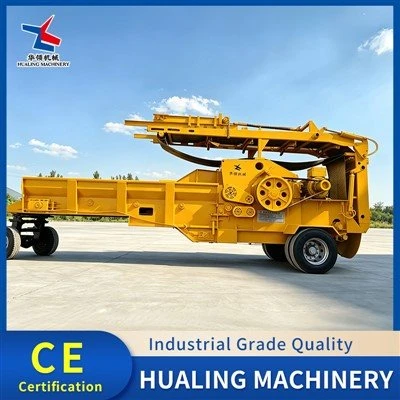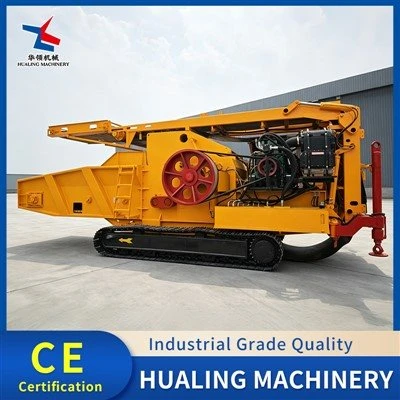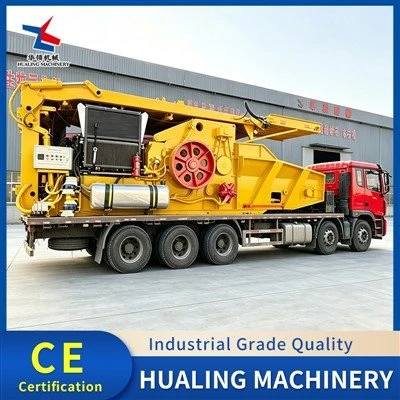

In the fields of biomass energy and wood processing, users often prioritize output particle size and processing capacity when selecting equipment, easily overlooking core factors directly affecting equipment stability, such as blade configuration and power distribution. In reality, controlling the 300mm feed and 30mm output span requires coordinated operation of the entire transmission system and crushing structure.
Working Principle and Core Structure Analysis: This model uses a 650r/min spindle speed paired with a 110kW main motor, achieving wood crushing through the rotational shearing of two sets of blades. The feed roller is driven by an independent 3-4kW motor, ensuring uniform feeding of logs with a diameter of 300mm; a 1.5kW oil pump motor provides continuous lubrication for the bearing system. This distributed power design avoids the risk of overloading a single motor, while the 218-size housing structure (2200×2150×1500mm) provides necessary rigid support for the 7100kg equipment.
How do technological differences affect practical applications? The combination of a dual-blade structure and a multi-motor system maintains a low failure rate at a throughput of 12-15 t/h-fewer blades reduce the difficulty of dynamic balancing, but require higher strength blade materials; the independent feeding system, while increasing power consumption by 3 kW, solves the problem of large-diameter timber jamming. Compared to an integrated transmission design, this modular power distribution is more suitable for continuous operation scenarios in biomass power plants.
Application Scenarios and Understanding Framework When evaluating this type of equipment, the following should be considered: the matching degree between spindle speed and motor power (650 r/min with 110 kW is a medium-speed heavy-duty type); the power consumption ratio of auxiliary systems (feeding/conveyor accounts for 5.5% of the main power); and the weight-to-size ratio of the housing (3.23 kg/dm³ indicates a reinforced structure). For fine crushing needs below 30 mm, the ease of blade replacement and bearing cooling solutions should be carefully examined.